
Ben Kirshner | University of Colorado Boulder
Posted 20 February 2021
(Descriptive text follows the bios and recommended citation below.)
Ben Kirshner is a Professor of Learning Sciences and Human Development at the University of Colorado Boulder. In his work with the Research Hub for Youth Organizing he co-designs educational tools and research studies in partnership with youth organizing groups and networks that build young people’s capacity and power. With the Critical Civic Inquiry research group he co-develops research-practice partnerships that increase the capacity of public schools to support transformative student voice and action civics. Ben’s book, Youth Activism in an Era of Education Inequality, received the social policy award for best authored book from the Society of Research on Adolescence.
Andrew Kohan can’t decide what he wants to be when he grows up, but for now he’s a working comics artist and illustrator regularly making trouble at Winnipeg City Hall. A trained community organizer with roots in the HIV/AIDS movement, he’s made art and noise with grassroots activists in DC, Chicago, Cleveland, and Toronto. More of his work is available at andrewkohan.com.
Recommended citation:
Kirshner, Ben, and Andrew Kohan. “Learning & Teaching in Youth Activism.” Sequentials, vol. 2, no. 1, 2021.
Text descriptions of page images:
Page 1
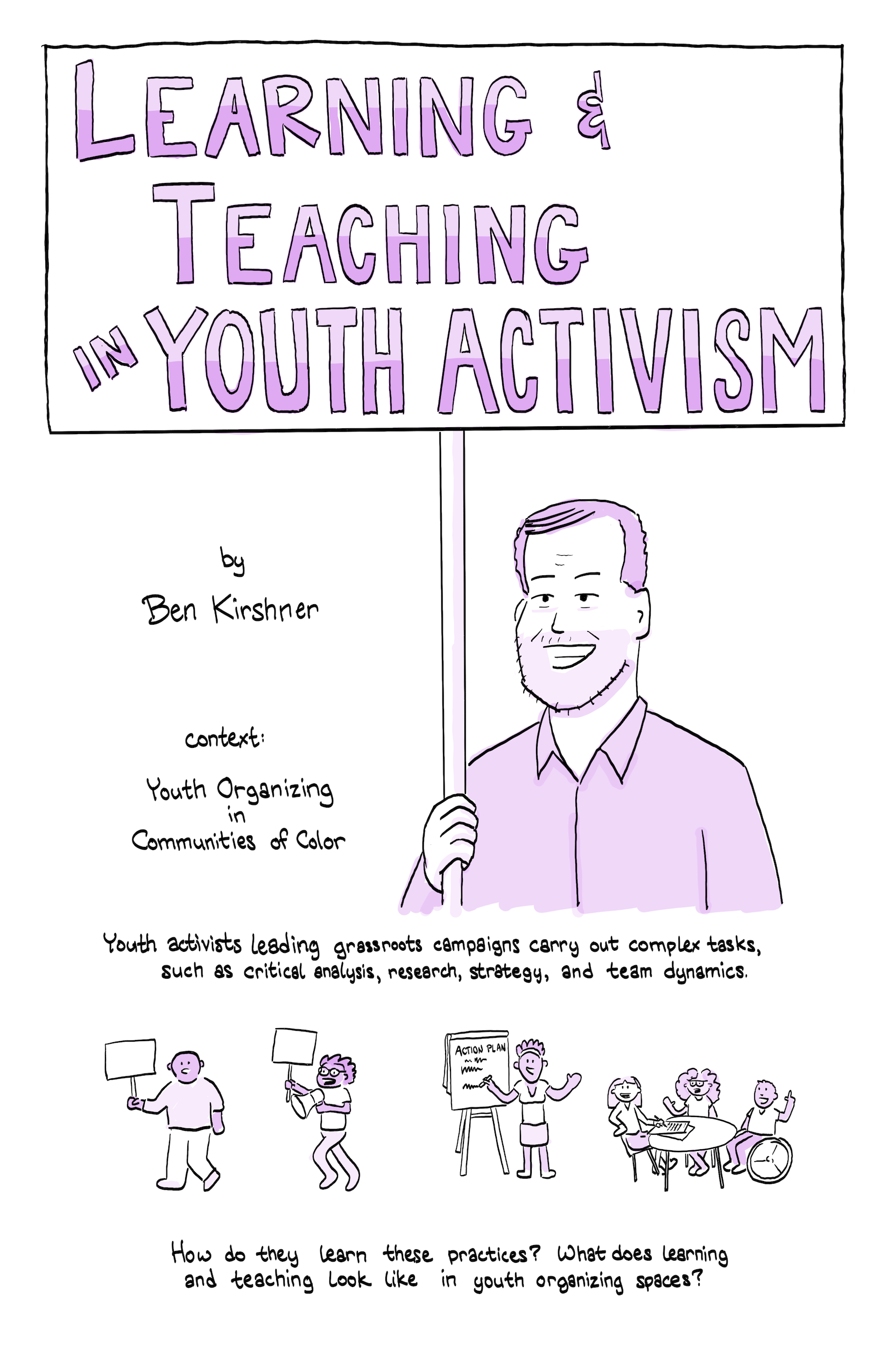
Title: Learning & Teaching in Youth Activism
by Ben Kirshner
Context: Youth organizing in communities of color
Comic image of Ben Kirshner, tall white man, holding a sign with the title on it.
Text: “Youth activists leading grassroots campaigns carry out complex tasks, such as critical analysis, research, strategy, and team dynamics.”
Comic images: Youth of color holding signs, using megaphone, presenting with flip chart, and sitting around table discussing.
Text: “How do they learn these practices? What does learning and teaching look like in youth organizing spaces?”
Page 2
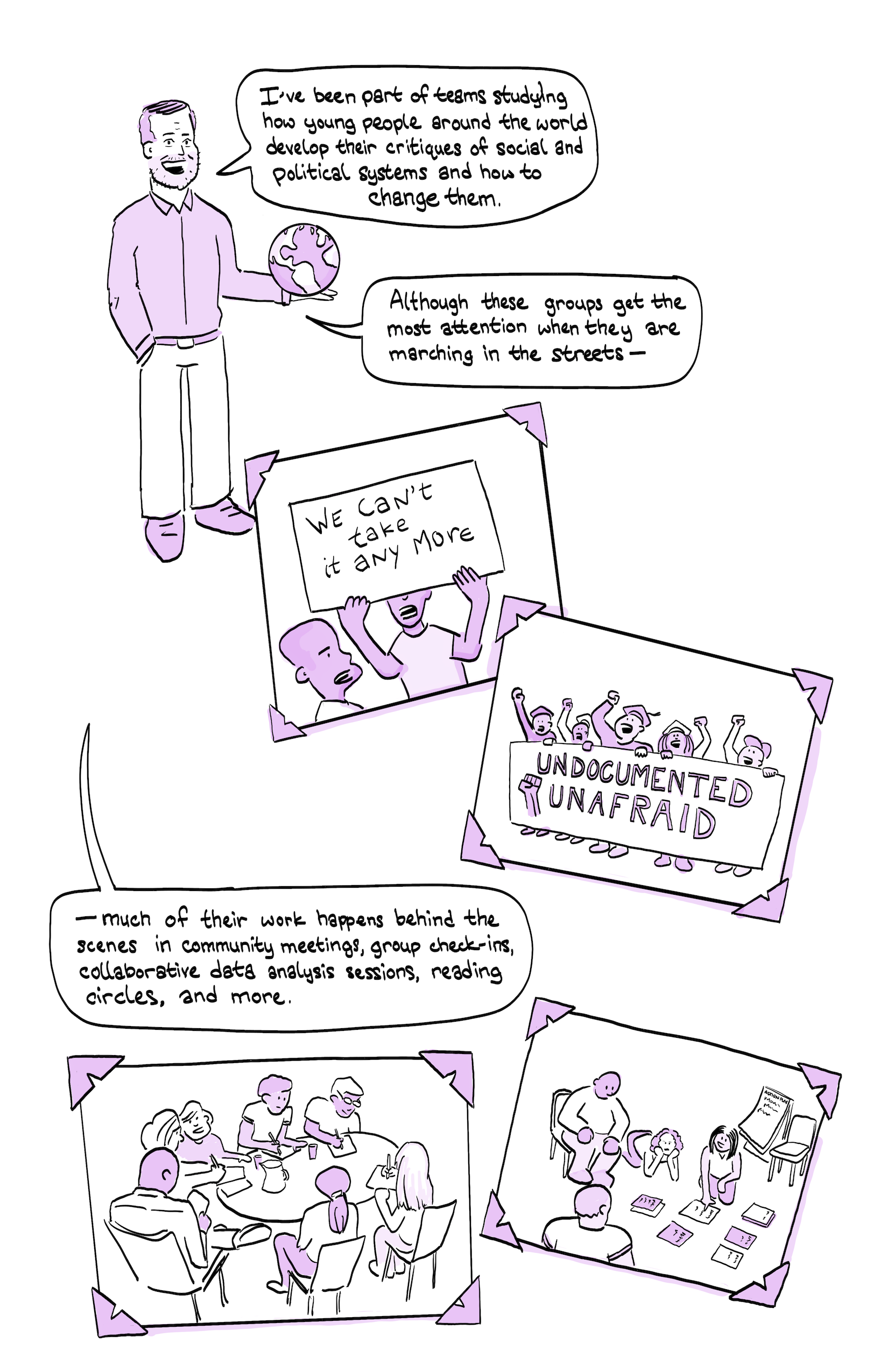
Comic image of Ben Kirshner, holding a globe.
Speech bubble 1: “I've been part of teams studying how young people around the world develop their critiques of social and political systems, and how to change them.”
Speech bubble 2: “Although these groups get the most attention when they are marching in the streets—”
Comic image of polaroid photo of protestors holding sign that reads: “We can’t take it anymore.”
Comic image of polaroid photos of protests: Polaroid 1 has people carrying banner that reads: “Undocumented and Unafraid.”
Ben speech bubble: “—much of their work happens behind the scenes in community meetings, group check-ins, collaborative data analysis sessions, reading circles, and more.”
Polaroid 2 is of a multiracial group of young people sitting around a table working. Polaroid 3 is of a multiracial group of young people sitting in a circle, two sitting on the floor, surrounding sheets of paper with a flipchart in the background.
Page 3
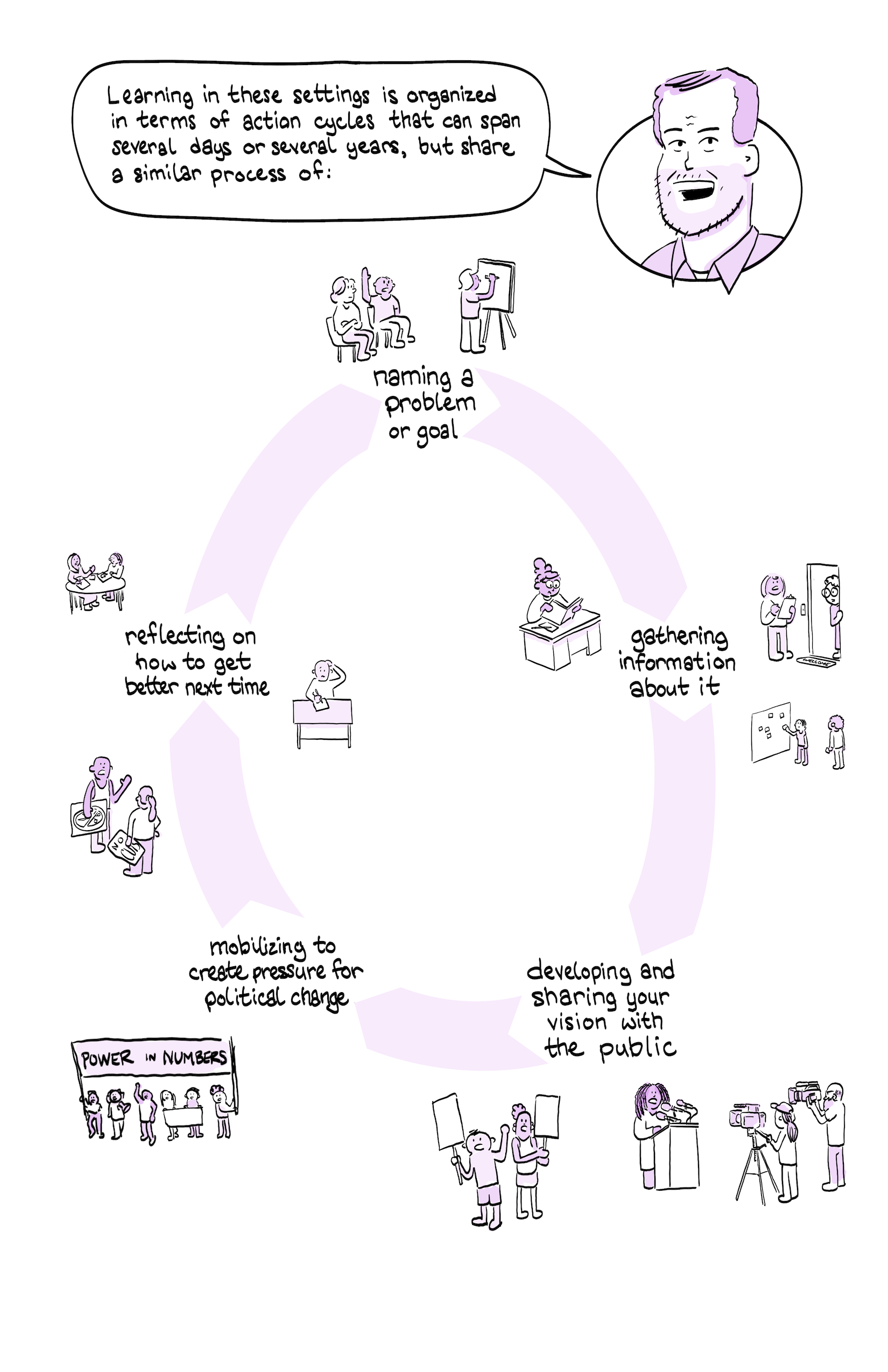
Comic image of Ben’s face in a circle with speech bubble that reads: “Learning in these settings is organized in terms of action cycles that can span several days or several years, but share a similar process of:”
Image of oval-shaped cycle diagram made of arrows with comic images interspersed at various Positions in the cycle.
Position 1, at the top of the oval: Text: “naming a problem or goal.” Image of a person at a flipchart while two people sit in chairs. One has their hand raised.
Moving clockwise from there, position 2: Text: “gathering information about it.” Image of a person reading a book at a desk. Image of a person with a clipboard canvassing at a neighbor’s front door. Image of two people organizing sticky notes on a wall.
Moving clockwise to position 3: Text: “developing and sharing your vision with the public.” Image of two people holding protest signs, one with a fist raised in the air. Image of a person speaking at a lectern while two people with news cameras look on.
Moving clockwise to position 4: Text: “mobilizing to create pressure for political change.” Image of a line of people marching under a banner that says “POWER IN NUMBERS.”
Moving clockwise to the final position in the cycle: Text: “reflecting on how to get better next time.” Image of two people discussing at a round table. Image of a person scratching their head while they write at a desk. Image of two people discussing while they hold protest signs down at their sides.
From that position, a final arrow points back to position 1, closing the cycle.
Page 4
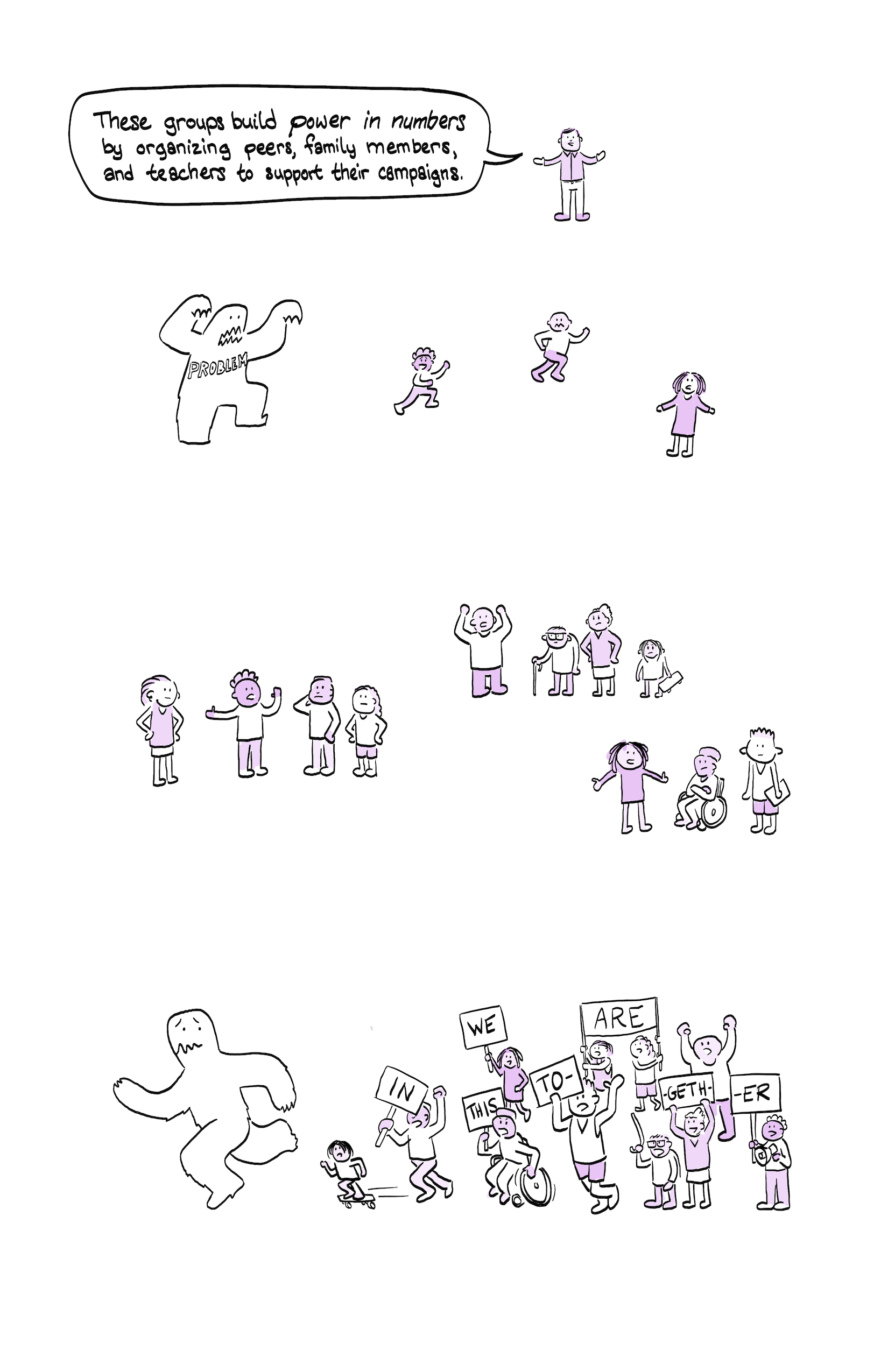
Comic image of Ben, full body but very tiny, with a speech bubble saying: “These groups build power in numbers by organizing peers, family members, and teachers to support their campaigns.”
From the top of the page to the bottom, a series of three images shows an evolution in youth organizing. At the top, a monster labeled “PROBLEM” looms with claws raised while three people cower and run away. Below that, three clusters of people gather, each cluster forming around one of the three people from the previous image. They gesture while speaking. Below that, all of the people from the previous images have come together to chase away the problem monster. They hold individual protest signs that when read together say: “We are in this together.”
Page 5
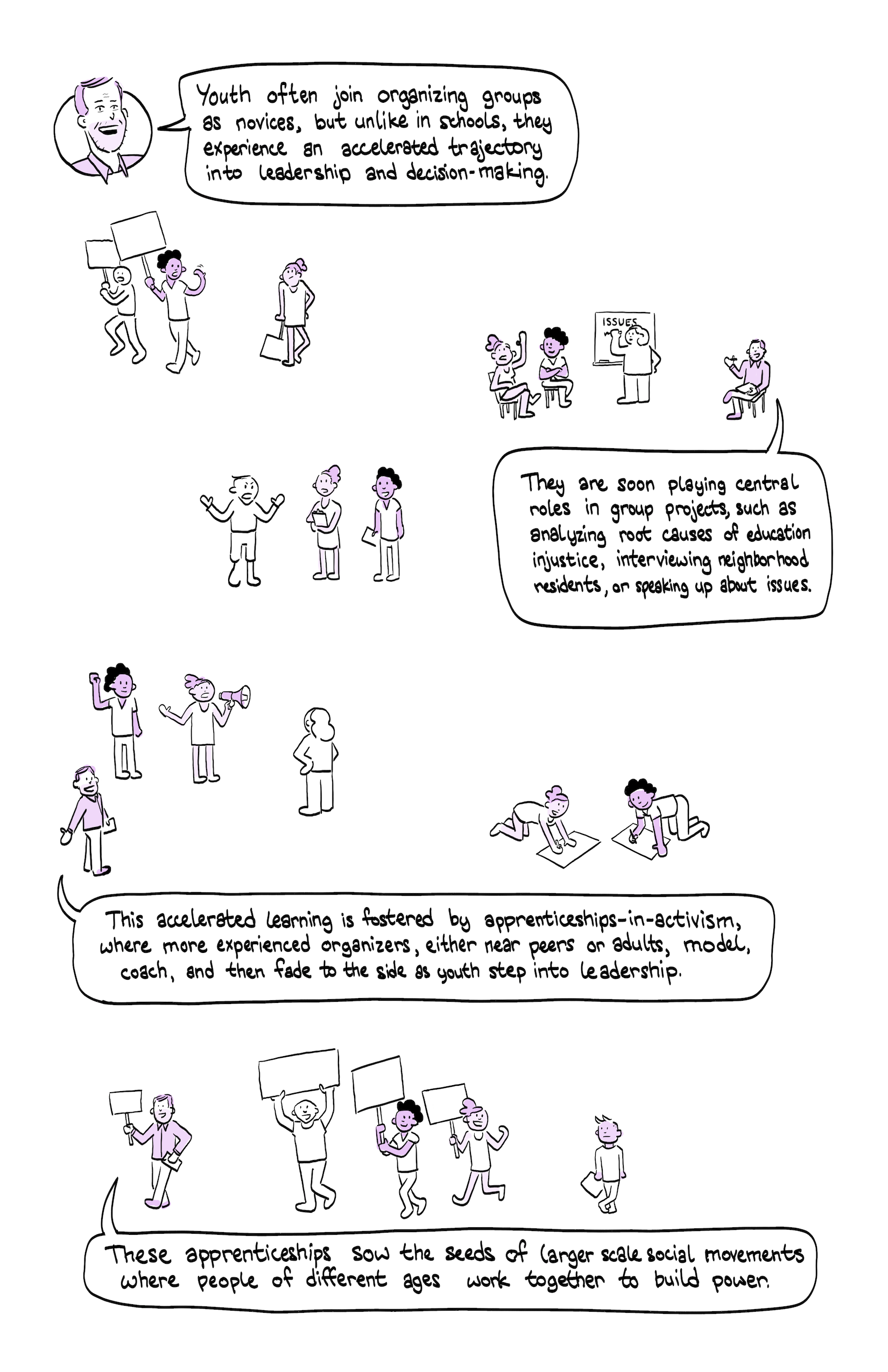
Comic of Ben’s face in a circle with speech bubble that says: “Youth often join organizing groups as novices, but unlike in schools, they experience an accelerated trajectory of leadership and decision-making.”
Series of comics images. Image 1: A young woman with a curly ponytail stands to the side of two others holding protest signs, who beckon to her to come along. Image 2: The same young woman is in a meeting, raising her hand as another person takes notes on whiteboard with the word “Issues” written across the top. Sitting in a chair in the meeting is Ben, with a speech bubble that says, “They are soon playing central roles in group projects, such as analyzing root causes of education injustice, interviewing neighborhood residents, or speaking up about issues.
Image 3: An angry person speaks with two activists holding clipboards. One of them is the young woman with the ponytail from before.
Image 4: The young woman with the ponytail speaks into a megaphone, with another activist (who beckoned to her earlier) standing at her side. In the foreground, Ben speaks: “This accelerated learning is fostered by apprenticeships-in-activism, where more experienced organizers, either near peers or adults, model, coach, and then fade to the side as youth step into leadership.”
Image 5: The young woman and the more experienced activist work on posters on the floor.
Image 6: A multiracial group of youth activists are marching with signs. Now the young woman with the ponytail is beckoning for a brand-new activist to join them, just as she had been encouraged in image 1. Ben’s speech bubble: “These apprenticeships sow the seeds of larger scale social movements where people of different ages work together to build power.”
Page 6
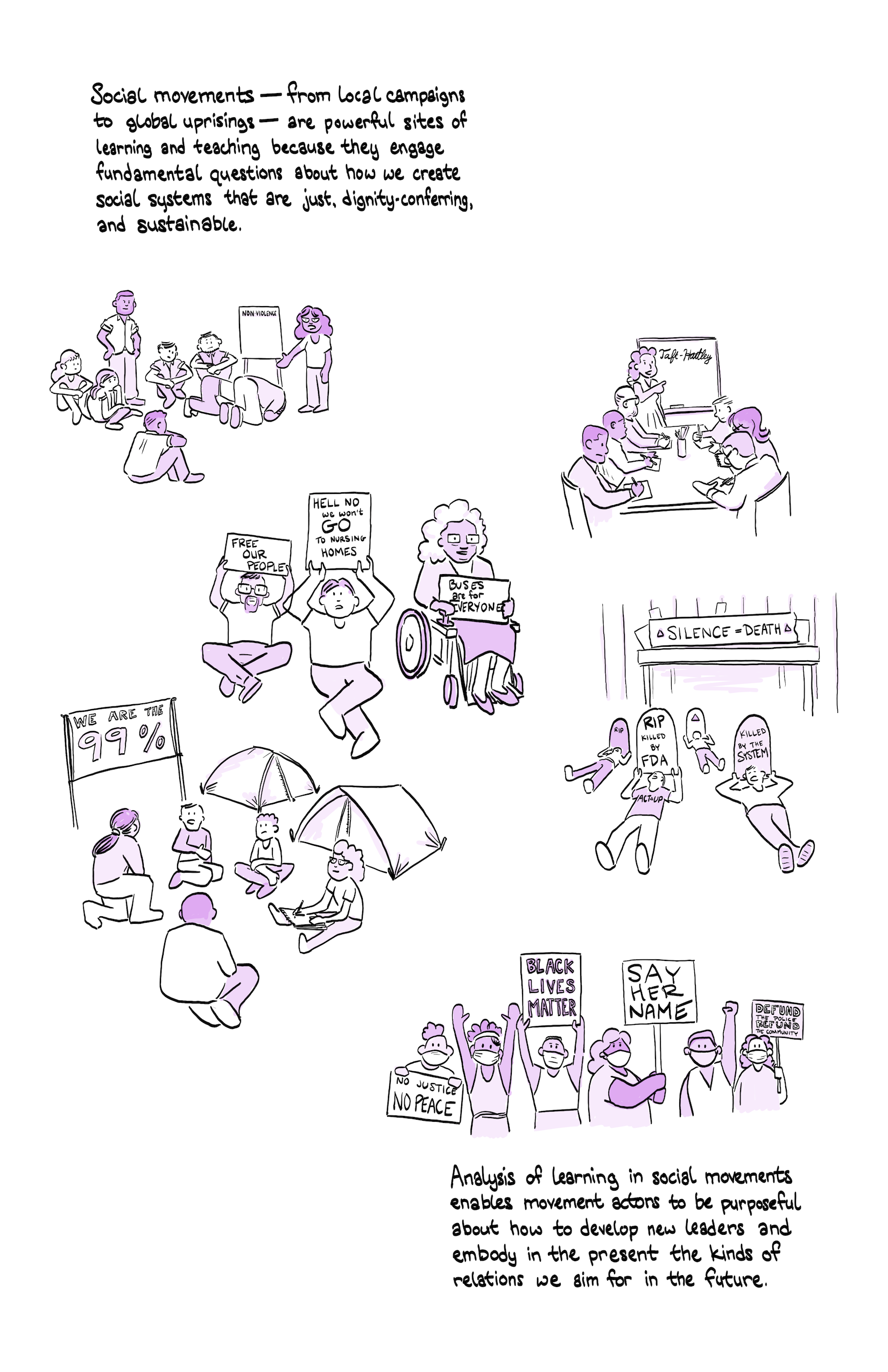
Text: “Social movements—from local campaigns to global uprisings—are powerful sites of learning and teaching because they engage fundamental questions about how we create social systems that are just, dignity-conferring, and sustainable.”
A series of comic images represent several social movements of today and from history. Image 1: a scene from a workshop with a cluster of activists sitting on the floor observing a nonviolence role-playing activity while a facilitator stands in front of a flipchart with “Non-violence” written across the top. Image 2: a group sits around a conference table taking notes while a woman speaks to them, pointing to a chalkboard that says “Taft-Hartley.” Image 3: a group of three people holding signs. Two are sitting on the ground. Their signs read, “Free our people” and “Hell no we won’t go to nursing homes.” The third person is a woman with gray hair sitting in a wheelchair, and her sign reads, “Buses are for everyone.” Image 4: ACT UP protesters lie on the ground while holding mock gravestones at their heads, reading “RIP,” “RIP killed by the FDA,” and “Killed by the system.” Behind them a banner reads, “Silence = death.” Image 5: In a scene from the Occupy Wall Street movement, a group of people crouch and sit in a cluster in front of camping tents and a sign that says, “We are the 99%.” Image 6: a multiracial group of protestors with signs, wearing masks. Person 1 holds sign that says, “No Justice No Peace.” Person 2 has her hands up in the air (as in “hands up, don’t shoot”). Person 3 holds a sign that says, “Black Lives Matter.” Person 4 stands in three-quarter profile and holds a sign that reads, “Say her name.” Person 5 holds their arm up in a Black Power fist. Person 6 holds a sign that says, “Defund the police. Refund the community.”
Text: “Analysis of learning in social movements enables movement actors to be purposeful about how to develop new leaders and embody in the present the kinds of relations we aim for in the future.”
Page 7
This comic is part of Learning to Engage: Movements and Sociocultural Theories of Learning.
For more, visit: AndrewKohan.com/LearningToEngage
Written by Ben Kirshner (a little sketch of Ben) (@bkirshner, kirshner@colorado.edu)
Art and lettering by Andrew Kohan (little sketch of Andrew) (@akohan, AndrewKohan.com)
Edited by Joe Curnow (little sketch of Joe) (@LearnSolidarity, joe.curnow@umanitoba.ca) & Tanner Vea (little sketch of Tanner) (@TannerVea, tvea@psu.edu)
To find out more about the research presented in this comic, go check out:
Kirshner, B. (2008). "Guided participation in three youth activism organizations: Facilitation, apprenticeship, and joint work." The Journal of the Learning Sciences, 17(1), 60-101.
Kirshner, B. (2015). Youth activism in an era of educatinal inequality. New York, NY: New York Universy Press.
For more examples of powerful youth organizing, check out the work of Padres & Jóvenes Unidos (https://padresunidos.org), Project VOYCE (https://www.projectvoyce.org), and Equal Education (https://equaleducation.org.za).
This comic was made possible by a grant from the Spencer Foundation (Grant #201900131). The views expressed are those of the authors and do not necessarily reflect the views of the Spencer Foundation.
©2020
This work is licensed under a Creative Commons Attribution-NonCommercial-ShareAlike 4.0 International License http://creativecommons.org/licenses/by-nc-sa/4.0