
A. Susan Jurow | University of Colorado Boulder
Molly Shea | University of Washington
Posted 20 February 2021
(Descriptive text follows the bios and recommended citation below.)
A. Susan Jurow is Professor of Learning Sciences and Human Development at University of Colorado Boulder. Her research explores how learning is situated in changing social and cultural practices. Dr. Jurow's publications have focused on learning disciplinary content in schools, how practices travel in and across contexts, and the ways in which learning is a part of social movements for justice.
Molly Shea is an Assistant Professor of Education at University of Washington. Her research considers issues of power in informal and formal learning environments and what people do to reorganize for more just social futures. This includes exploring how people build knowledge and expertise as they seek to transform their social circumstances, how people leverage technology to inform and change practices, and how people attend to power and valued dimensions of learning in the co-design of learning environments given histories of injustice.
Andrew Kohan can’t decide what he wants to be when he grows up, but for now he’s a working comics artist and illustrator regularly making trouble at Winnipeg City Hall. A trained community organizer with roots in the HIV/AIDS movement, he’s made art and noise with grassroots activists in DC, Chicago, Cleveland, and Toronto. More of his work is available at andrewkohan.com.
Recommended citation:
Jurow, A. Susan, Molly Shea, and Andrew Kohan. “Equity-Oriented Scale Making.” Sequentials, vol. 2, no. 1, 2021.
Text descriptions of page images:
Page 1
Title: Equity-Oriented Scale-Making
by A. Susan Jurow & Molly Shea
Images of Jurow and Shea from the shoulders up.
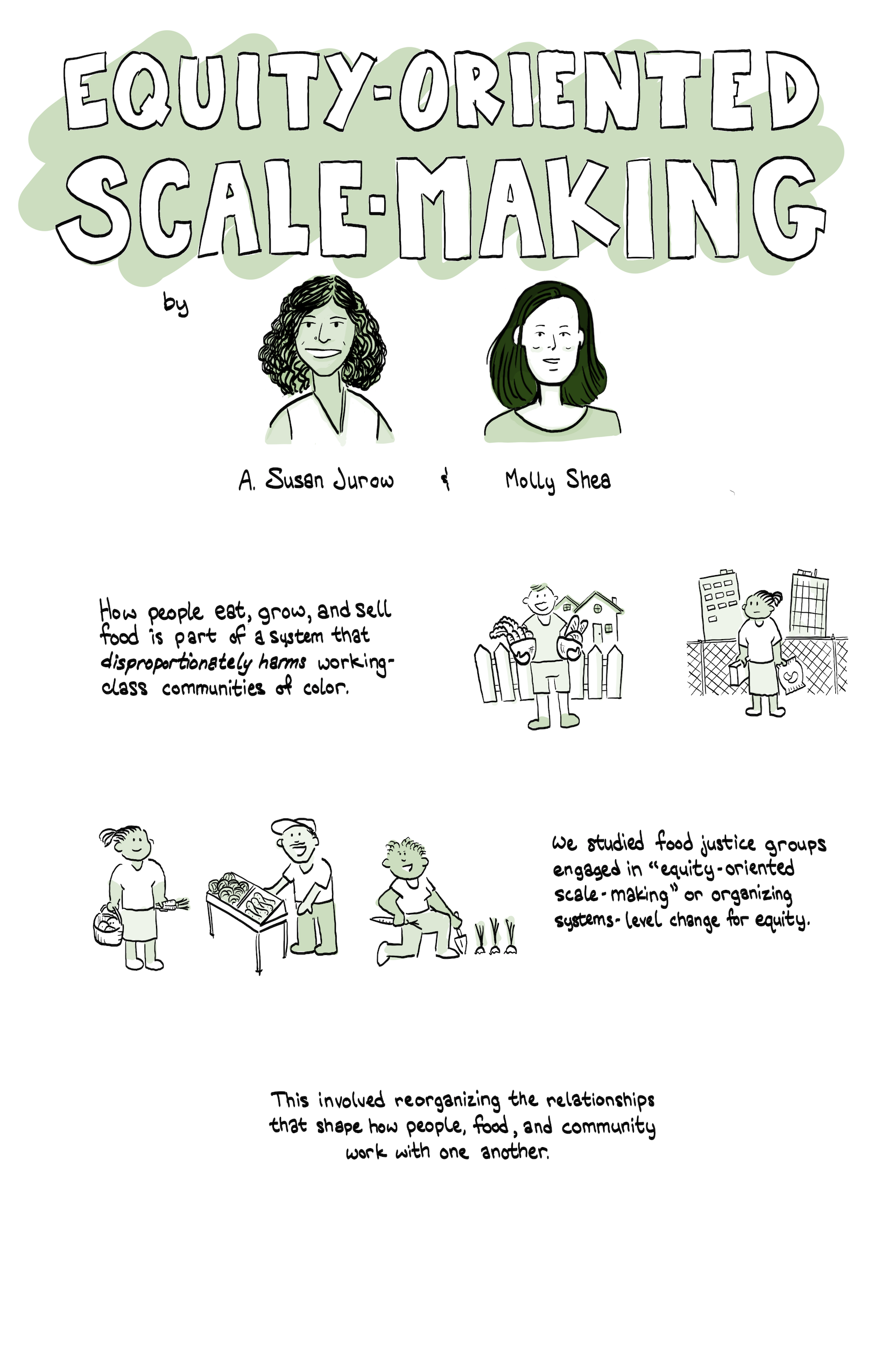
Text: “How people eat, grow, and sell food is part of a system that disproportionately harms working-class communities of color.”
Image of a white man standing in front of a single-family home with a picket fence, carrying two bags of fresh produce. Image of a Black woman standing in front of two high-rise buildings and a chain-link fence, carrying a box of processed food and a bag of chips.
In the next row down, image of three smiling people: A Latina woman shopping at a farmer’s market and carrying fresh food, a Latino man working behind the produce table, and a Black person harvesting carrots. Text: “We studied food justice groups engaged in “equity-oriented scale-making” or organizing systems-level change for equity.”
Text: “This involved reorganizing the relationships that shape how people, food, and community work with one another.”
Page 2
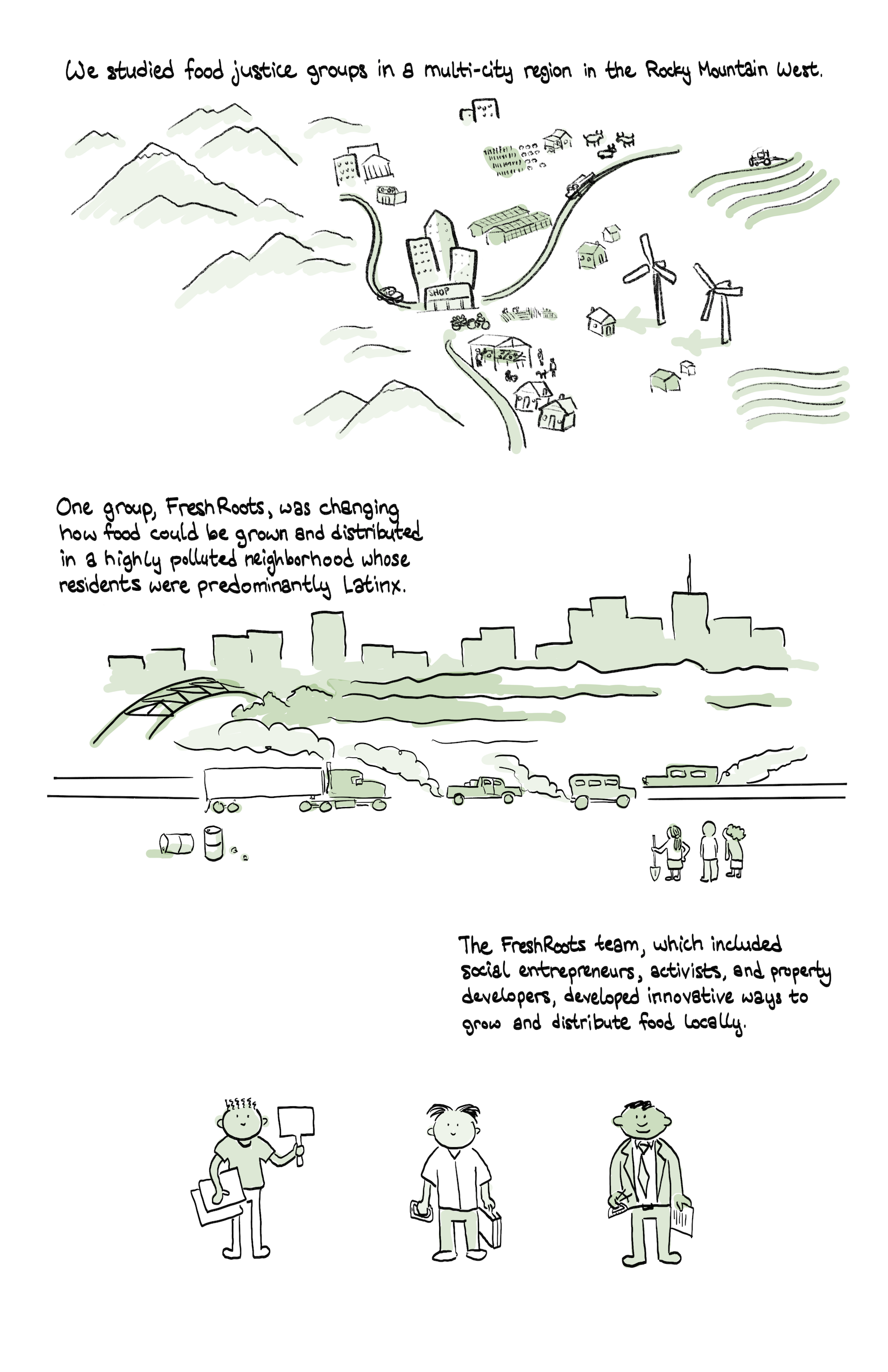
Text: “We studied food justice groups in a multi-city region in the Rocky Mountain West.”
Comic image of a mountain and valley landscape showing roads connecting different parts of communities, including businesses, agricultural land, wind turbines, an outdoor food market, and homes.
Text: “One group, FreshRoots, was changing how food could be grown and distributed in a highly polluted neighborhood whose residents were predominately Latinx.”
Comic image of an urban skyline looming above a highway with a cargo truck and personal vehicles spewing exhaust. In the foreground, two storage barrels, one has tipped over and is dripping liquid. A group of three residents stand observing the scene. One of them is holding a shovel.
Text: “The FreshRoots team, which included social entrepreneurs, activists, and property developers, developed innovative ways to grow and distribute food locally.”
Comic image of three people. One person is an activist holding protest signs. The second is an entrepreneur carrying a briefcase. The third is a man dressed in a suit and carrying a business document.
Page 3
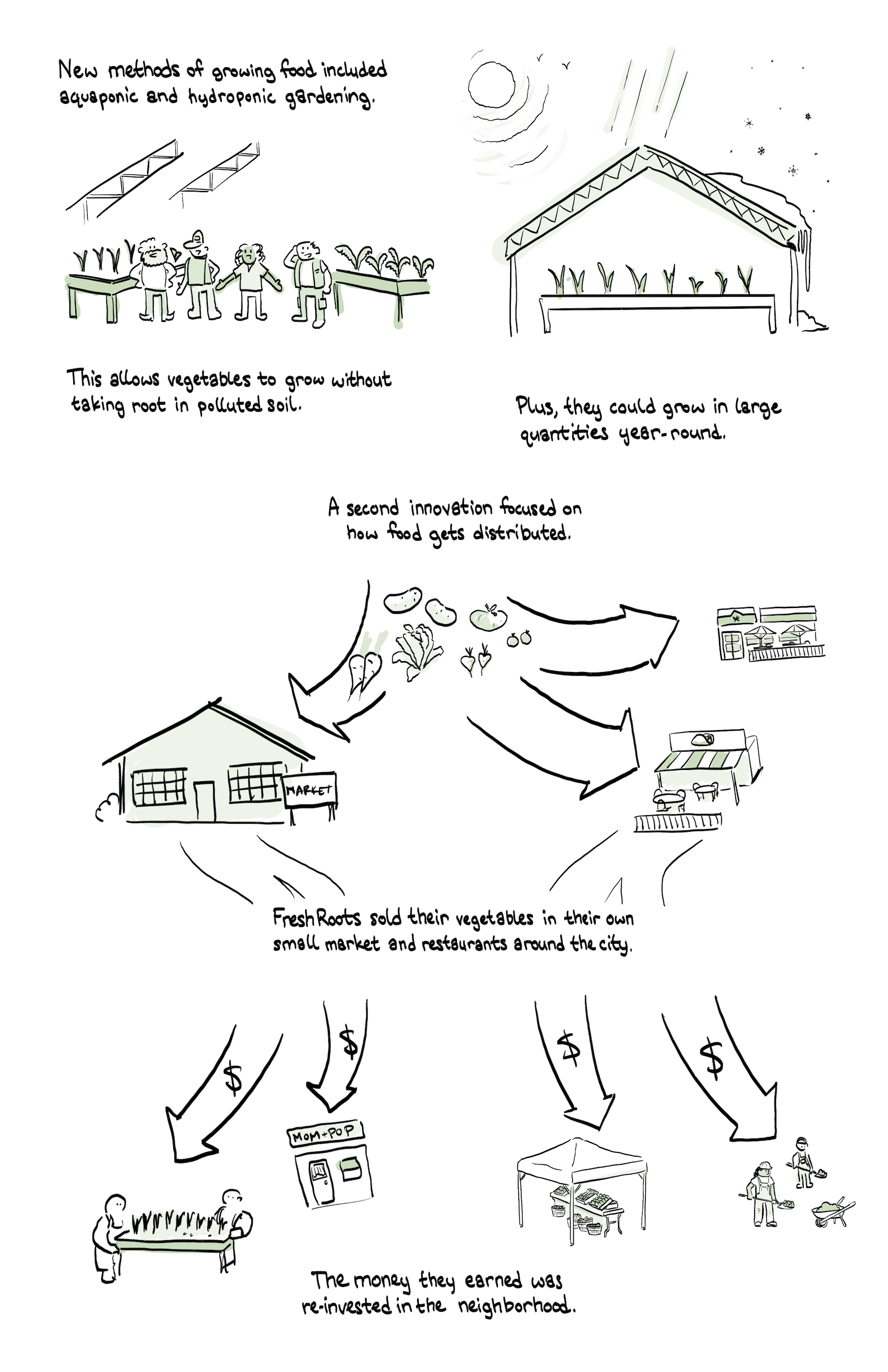
Text: “New methods of growing food included aquaponic and hydroponic gardening.”
Comic image of a group of people admiring raised hydroponic beds inside of a greenhouse facility. Text: “This allows vegetables to grow without taking root in polluted soil.” Comic image of various forms of weather—sun, rain, and snow—passing overhead while the crops in the greenhouse remain undisturbed. Text: “Plus, they could grow in large quantities year-round.”
Text: “A second innovation focused on how food gets distributed.”
Comic image shows divergent arrows carrying carrots, lettuce, potatoes, a tomato, turnips, and apples in multiple directions, to a supermarket and to different restaurants. Beneath those locations, additional arrows extend downward, with dollar signs flowing to a pair of farmers, a mom-and-pop store, an outdoor produce stand, and construction workers. Text: “FreshRoots sold their vegetables in their own small market and restaurants around the city.”
Text: “The money they earned was re-invested in the neighborhood.”
Page 4
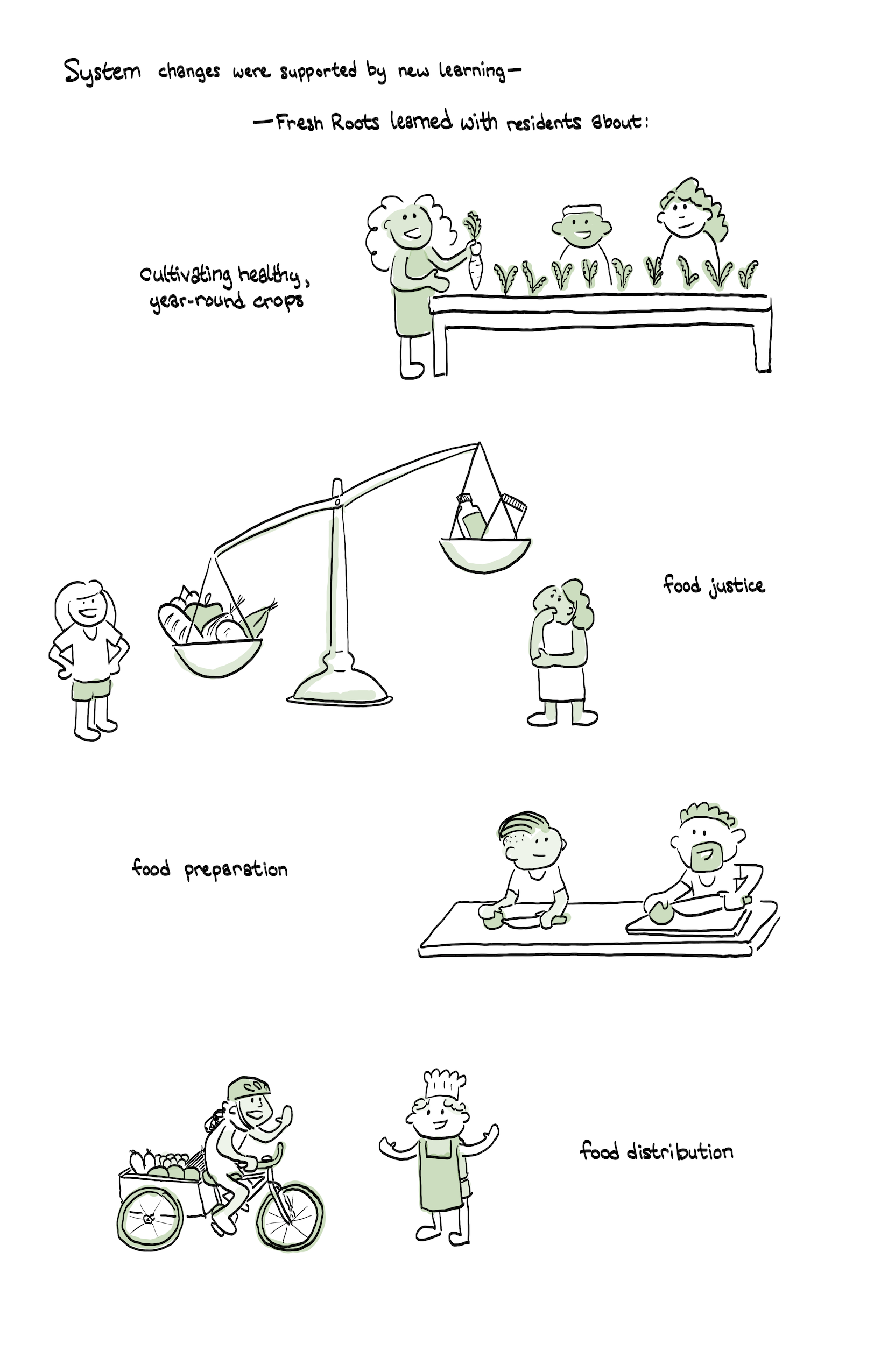
Text: “System changes were supported by new learning—FreshRoots learned with residents about: Cultivating healthy, year-round crops.” Comic image shows a multi-racial group of people standing around a raised bed of crops. A woman at the left of the bed holds up a carrot, fresh from the ground, smiling and gesturing toward it.
Comic image of an oversized scale of justice, with a white woman smiling next to a heavily weighed scale arm that is carrying fresh, healthy foods. On the other side, next to a sparer scale arm, carrying prepackaged foods, a Brown woman looks concerned. Text: “Food justice.”
Text: “Food preparation” Comic image of a person with a fauxhawk and a man with a goatee working at a counter. The man with the goatee is cutting produce on a cutting board while the other person looks on, also holding produce and a knife.
Comic image of a woman riding a cycle with a cargo basket full of produce in the back. She smiles and waves to a chef in an apron and chef’s hat, his arms outstretched to greet her. Text: “Food distribution.”
Page 5
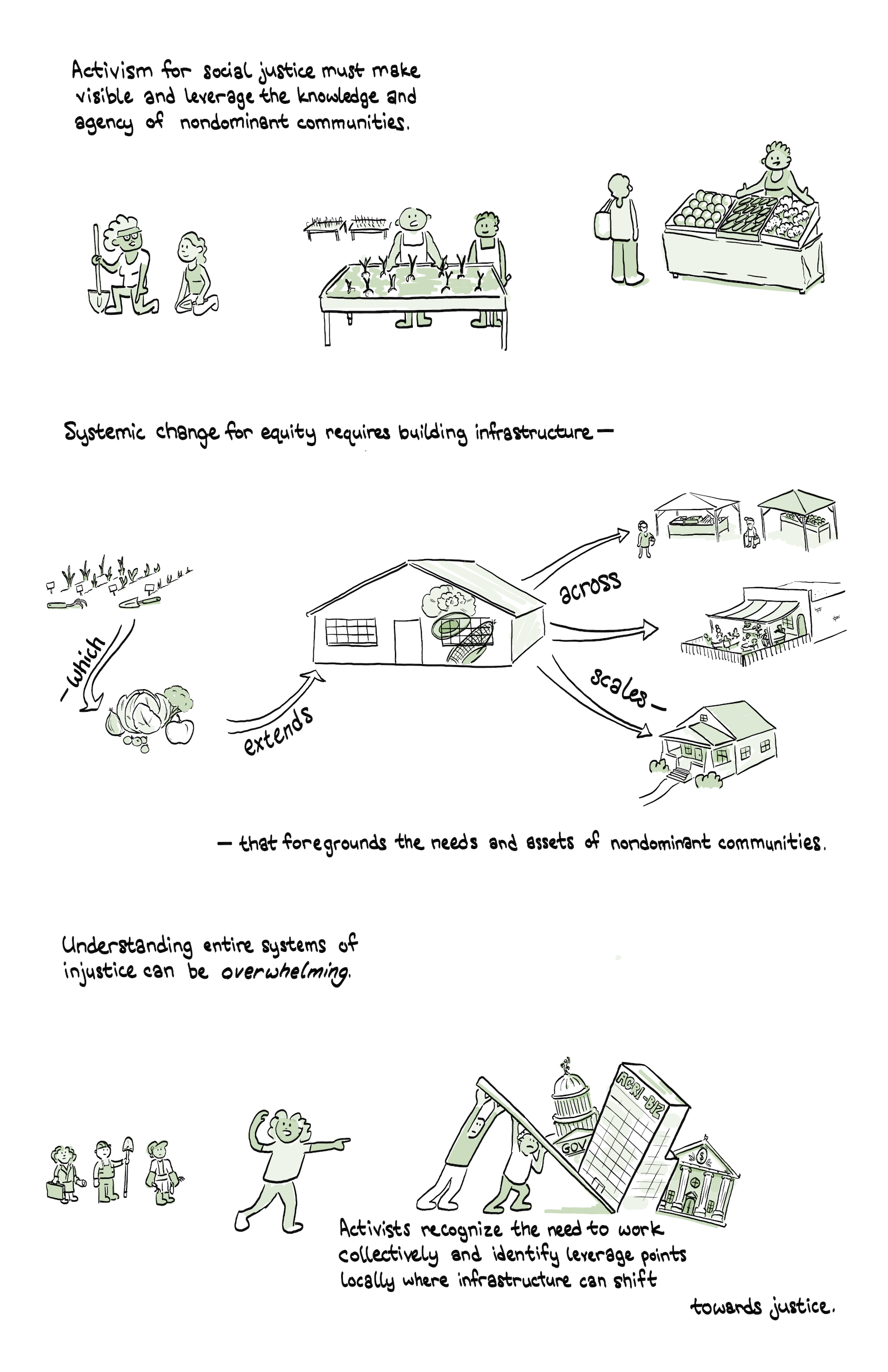
Text: “Activism for social justice must make visible and leverage the knowledge and agency of nondominant communities.”
Comic image of a Black woman and a Latina woman kneeling outdoors. The Black woman is holding a shovel and pointing down at the soil, while the Latina woman observes. Comic image of a Latino man and a Black person standing behind a bed of crops, with additional beds of crops in the background. Comic image of a Black woman standing behind a produce stall and gesturing at three types of produce, while a woman carrying a tote bag on her shoulder looks over the produce.
Text: “Systemic change for equity requires building infrastructure—”
Comic image flowchart shows different stages of production and distribution of fruits and vegetables, with the text “which extends across scales” integrated into the flow.
Text: “—that foreground the needs and assets of nondominant communities. Understanding entire systems of injustice can be overwhelming.”
Comic image of a Black woman gesturing leading a group of workers and entrepreneurs forward toward a pair of community members physically overturning a landscape with a bank and buildings labeled “GOV” and “AGRI-BIZ.”
Text: “Activists recognize the need to work collectively and identify leverage points locally where infrastructure can shift… towards justice.”
Page 6
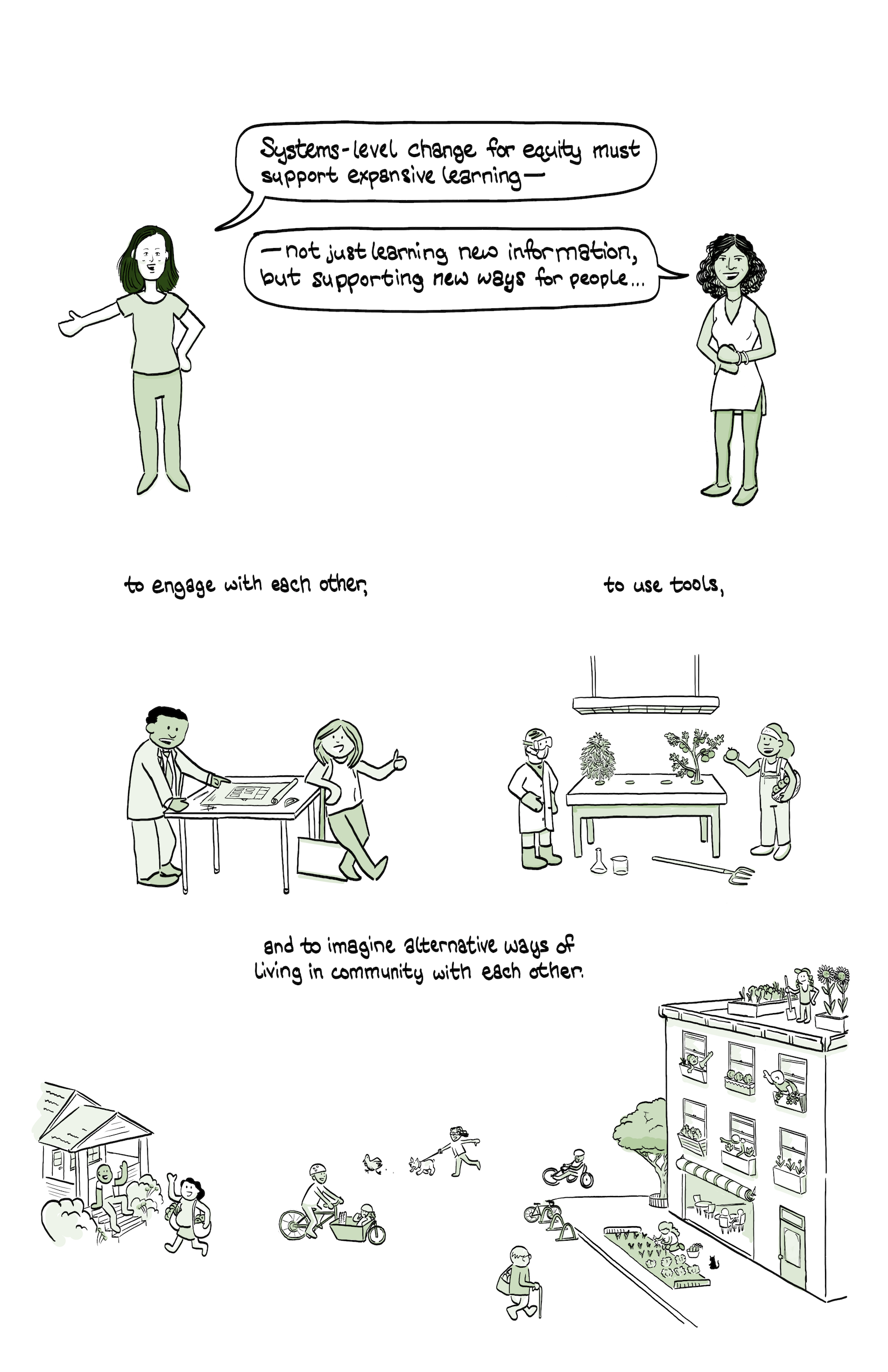
Comic images of Molly Shea and A. Susan Jurow stand at the sides of the page with speech bubbles in the center. Molly says, “Systems-level change for equity must support expansive learning—” Susan says, “—not just learning new information, but supporting new ways for people…”
Text: “to engage with each other.” Comic image of an activist and a businessman talking at a table over a project blueprint. Text: “to use tools,” Comic image of a man in a lab coat and a woman holding a basket of fruit talking beside a table with plants under a grow lamp. There is volumetric flask and a beaker next to a rake.
Text: “and to imagine alternative ways of living in community with each other.”
Comic image of an active neighborhood scene. On the left, a Black man on the front stoop of his house waves to a white woman walking by with bags full of produce. In the center, a person cycles by, carrying a child in a front car. A woman is pulled along by a leashed dog, who is chasing after a running chicken. An elderly person walks with a cane. A person rides a recumbent bike. On the right, a three-story building has a restaurant on the ground floor and apartments above. A woman in a baseball cap and carrying a shovel tends a rooftop garden with sunflowers. Two neighbors wave to one another out of their apartment windows. In front of the building, on a tree-lined block, a woman looks after a sidewalk garden plot while a black cat watches her.
Page 7
This comic is part of Learning to Engage: Movements and Sociocultural Theories of Learning.
For more, visit: AndrewKohan.com/LearningToEngage
Written by A. Susan Jurow (a little sketch of Susan) (@susanjurow, susan.jurow@colorado.edu) and Molly Shea (a little sketch of Molly) (@mvshea, mvshea1@uw.edu)
Art and lettering by Andrew Kohan (little sketch of Andrew) (@akohan, AndrewKohan.com)
Edited by Joe Curnow (little sketch of Joe) (@LearnSolidarity, joe.curnow@umanitoba.ca) & Tanner Vea (little sketch of Tanner) (@TannerVea, tvea@psu.edu)
To find out more about the research presented in this comic, go check out:
Jurow, A. S., & Shea, M. (2015). "Learning in equity-oriented scale-making projects." Journal of the Learning Sciences, 24(2), 286-307.
This comic was made possible by a grant from the Spencer Foundation (Grant #201900131). The views expressed are those of the authors and do not necessarily reflect the views of the Spencer Foundation.
©2020
This work is licensed under a Creative Commons Attribution-NonCommercial-ShareAlike 4.0 International License http://creativecommons.org/licenses/by-nc-sa/4.0